
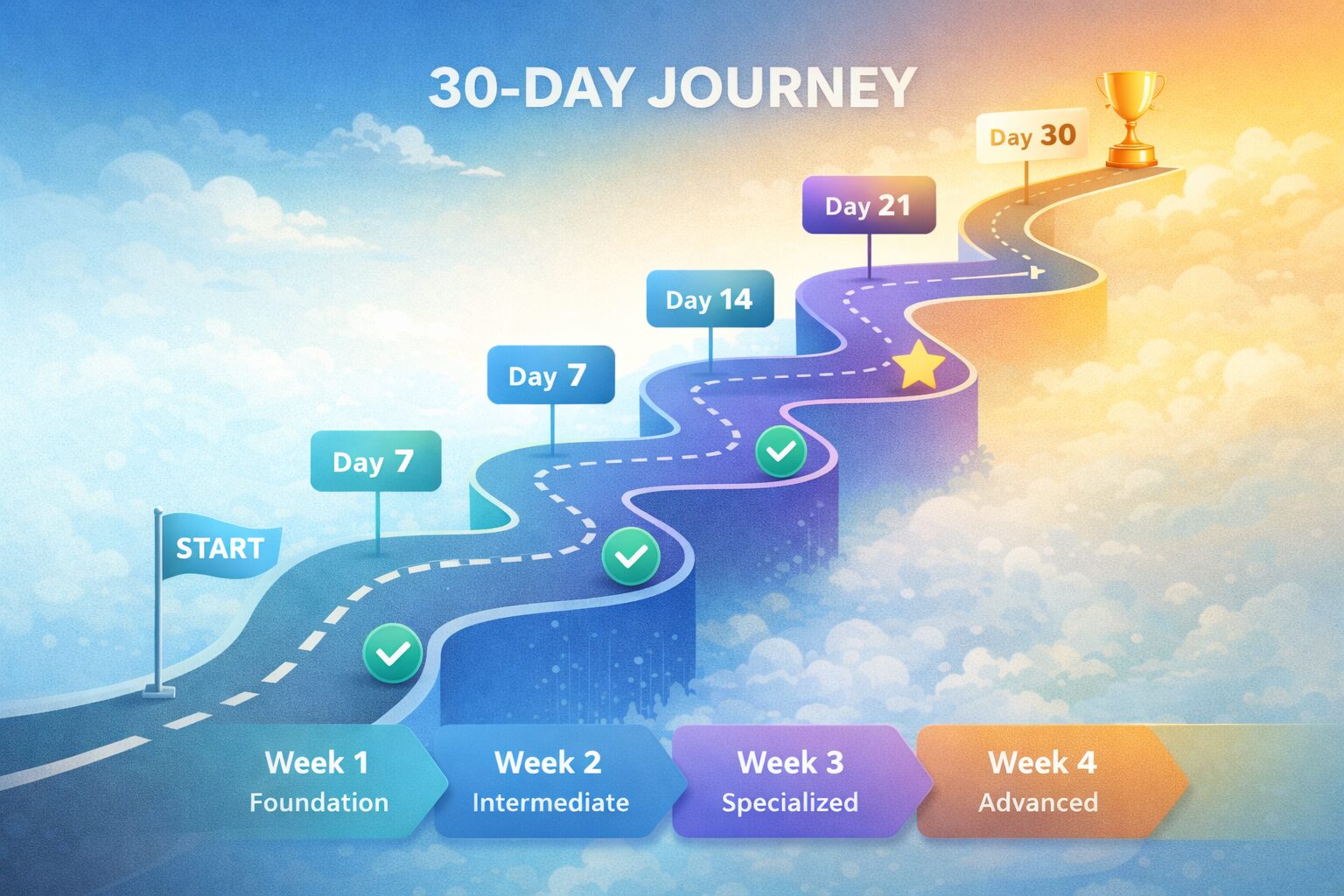
 Most people want to learn AI but don’t know where to start. However, this structured AI learning path takes you from complete beginner to confident user in just 30 days. Each week builds on the last, creating sustainable skills.
Let’s break down your journey into manageable daily steps.
Table of Contents
Week 1: Foundation of Your AI Learning Path
Days 1-2: Choose Your AI Learning Path Platform
First, you need the right tools. Start with free platforms that don’t require technical knowledge.
Create accounts on ChatGPT and Claude.ai. Both offer generous free tiers. Spend 30 minutes exploring each interface.
Notice how they respond differently to the same question. This comparison teaches you about AI capabilities and limitations.
Days 3-4: Master Basic Prompting
Prompting is how you communicate with AI. Good prompts get great results. Poor prompts waste time.
Practice this exercise. Ask: “Tell me about dogs.” Then ask: “Explain the three main differences between Golden Retrievers and Labrador Retrievers for first-time dog owners.”
Notice the quality difference? Specific, detailed prompts yield better responses. This is your foundation skill.
Days 5-7: AI Learning Path Daily Practice Routine
Establish a daily AI habit. Spend 15 minutes each day on real tasks. Draft an email, brainstorm ideas, or summarize an article.
According to research published in Nature, consistent practice with AI tools significantly improves productivity. Start building that habit now.
Keep a simple log. Note what worked and what didn’t. This reflection accelerates learning.
Week 2: Intermediate AI Learning Path Skills
Days 8-10: Advanced Prompting Techniques
Now, level up your prompting. Learn to provide context, specify format, and request iterations.
Try this prompt structure: “I’m a [role] working on [task]. I need [specific output] in [format]. My constraints are [limitations]. Please provide [deliverable].”
For example: “I’m a marketing manager creating a campaign. I need three email subject lines in casual tone. My constraint is 50 characters max. Please provide options with open rate predictions.”
Days 11-13: Using AI for Work Tasks
Apply AI to your actual job. Identify three repetitive tasks you do weekly. Use AI to streamline them.
Common applications include email responses, meeting summaries, and report writing. Furthermore, try data analysis, presentation outlines, and project planning.
Track time saved. Most users report 30-50% efficiency gains on automated tasks.
Days 14: Mid-Point Assessment
Pause and reflect. What AI applications work best for you? Which tools feel most natural?
Adjust your focus based on results. Double down on successful applications. Drop what doesn’t serve you.
Week 3: Specialized AI Learning Path Applications
Days 15-17: Content Creation Mastery
Explore AI for creative work. Write blog posts, social media content, or marketing copy. The key is iteration and refinement.
Start with AI-generated outlines. Then flesh out sections with your expertise. Edit for voice and accuracy. This collaboration produces excellent results.
Additionally, experiment with different writing styles. Ask AI to make content more casual, professional, or technical. Learn to guide tone effectively.
Days 18-20: Research and Analysis
Use AI as a research assistant. Upload documents and ask targeted questions. Summarize long articles or reports quickly.
Try tools like Perplexity AI for research with citations. This helps verify AI-generated information against sources.
Practice synthesizing information from multiple sources. Ask AI to compare viewpoints or identify trends across documents.
Days 21: Problem-Solving with AI
Tackle a real challenge using AI. Maybe it’s planning an event, solving a technical problem, or brainstorming solutions.
Use AI as a thinking partner. Ask it to play devil’s advocate. Request alternative perspectives. Challenge your assumptions.
Week 4: Advanced AI Learning Path Techniques
Days 22-24: Multi-Step Workflows
Now, create complex workflows. Chain multiple AI interactions together for sophisticated outcomes.
For example, use AI to brainstorm blog topics, then outline the best one, then draft sections, then create social media posts promoting it.
Each step builds on the previous output. This workflow thinking multiplies AI’s value significantly.
Days 25-27: AI Learning Path Tool Exploration
Branch beyond ChatGPT and Claude. Explore specialized tools for your field. Designers might try Midjourney. Developers could explore GitHub Copilot.
Marketers benefit from Jasper or Copy.ai. Researchers love Consensus or Elicit. Find tools that match your specific needs.
Spend one hour testing three new tools. Evaluate which ones deserve deeper exploration.
Days 28-29: Integration and Automation
Think about long-term AI integration. How can these tools become part of your daily workflow?
Set up templates for common tasks. Create prompt libraries for frequent requests. Build systems that make AI usage effortless.
Consider tools like Zapier or Make.com that connect AI with your other software. Automation amplifies AI’s impact.
Day 30: Your AI Learning Path Next Chapter
Reflect on your 30-day journey. What transformed in your work? Which skills matter most?
Create a personal AI strategy document. List your top five use cases. Identify tools you’ll use regularly. Set learning goals for the next month.
Measuring Your Progress
Skills Checklist
By day 30, you should confidently do the following tasks. First, write effective prompts that get quality results. Second, use AI for common work tasks efficiently.
Third, iterate and refine AI outputs professionally. Fourth, integrate AI into your daily workflow naturally. Fifth, identify appropriate AI tools for specific challenges.
Time Savings Goal
Most people following this AI learning path save 5-10 hours weekly by day 30. Some save even more. Track your actual time savings to measure success.
Common Challenges on Your AI Learning Path
Information Overload
New AI tools launch constantly. Don’t try to learn everything. Focus on mastering fundamentals first. Specialized tools come later.
Perfectionism
AI outputs aren’t perfect. They require human review and refinement. Embrace this collaborative approach instead of expecting flawless results.
Inconsistent Practice
Daily practice matters more than duration. Fifteen minutes daily beats two hours on weekends. Consistency builds lasting skills.
Beyond 30 Days
This AI learning path is just the beginning. After 30 days, you’ll have solid foundations. The real magic happens when you continue learning.
Join AI communities online. Follow r/artificial or AI-focused newsletters. Share your experiences and learn from others.
Furthermore, stay curious about new developments. The AI field evolves rapidly. Continuous learning keeps you ahead.
Most importantly, keep experimenting. Your best AI applications will emerge from playful exploration and real-world problem-solving.
Your Journey Starts Today
You now have a complete 30-day AI learning path. The roadmap is clear. The tools are free. The only requirement is commitment.
Thousands of professionals have transformed their careers following similar paths. The difference between them and everyone else? They started.
Don’t wait for perfect conditions. Begin today with day one. Thirty days from now, you’ll thank yourself for taking action.
The AI revolution is here. Your AI learning path begins right now.
Ready to start your journey? Download our free 30-day AI learning tracker and begin day one immediately.