Start with AI: A Simple, Practical Guide for Beginners
Artificial intelligence is suddenly everywhere — in headlines, products, and conversations at work. And if you’re feeling curious, excited, and a little overwhelmed all at once, you’re not alone.
The good news?
You don’t need to become an expert, learn to code, or “keep up” with everything happening in AI.
This guide is designed to help you start with AI in a calm, practical way, even if you feel like you’re coming in late.
Table of Contents
What does “starting with AI” actually mean?
For most people, starting with AI does not mean:
- Learning machine learning
- Understanding neural networks
- Building models
- Writing code
Instead, it means learning how to use AI as a tool — one that helps you think, write, organize, and work more effectively.
Think of AI as:
- A thinking assistant
- A first-draft generator
- A summarizer
- A brainstorming partner
When used well, it quietly saves time and reduces friction in everyday work.
Why AI feels overwhelming (and why that’s normal)
AI moves fast. Headlines are loud. Tools appear daily. And a lot of content makes it sound like you’re already behind.
In reality, most professionals are:
- Still figuring out how AI fits into their work
- Using only one or two tools
- Learning through trial, not theory
Feeling overwhelmed usually isn’t a sign that you’re behind — it’s a sign that the conversation isn’t beginner-friendly.
That’s exactly what we’re fixing here.
The best way to start with AI (a simple framework)
You don’t need a massive plan. You need a small, intentional starting point.
Step 1: Focus on outcomes, not technology
Instead of asking:
“How does AI work?”
Ask:
“What would I like help with?”
Good starting points include:
- Writing emails or documents
- Summarizing long material
- Brainstorming ideas
- Clarifying complex topics
- Learning something faster
AI works best when it’s applied to tasks you already do.
Step 2: Pick one beginner-friendly AI tool
You don’t need dozens of tools. One is enough.
A conversational AI tool (like ChatGPT or similar alternatives) is often the easiest place to start because:
- There’s no setup
- You can ask questions in plain English
- You get immediate feedback
The goal isn’t mastery — it’s familiarity.
👉 You can explore recommended tools on the Tools & Resources page.
Step 3: Use AI on a real task today
Avoid abstract experiments.
Instead, try:
- Asking AI to rewrite a rough email more clearly
- Summarizing a long document you don’t want to read
- Generating an outline for something you’re stuck on
Small, practical wins build confidence quickly.
Step 4: Repeat, don’t optimize
You don’t need perfect prompts or advanced techniques.
The fastest way to get comfortable with AI is simple repetition:
- Try it
- See what works
- Adjust slightly next time
Confidence comes from usage, not theory.
Common beginner questions (answered honestly)
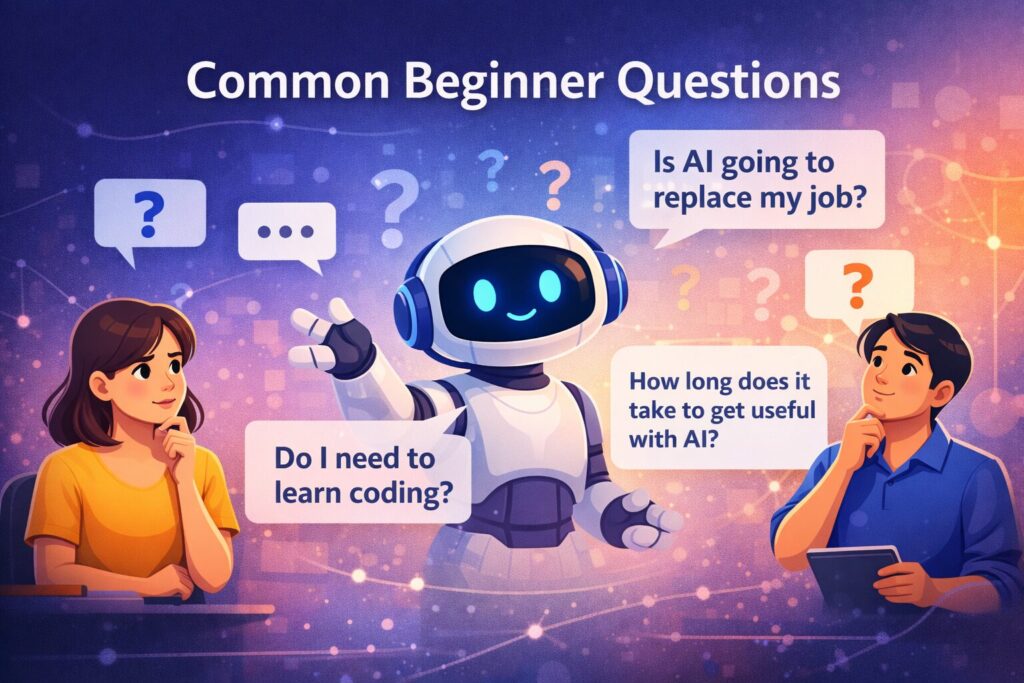
“Do I need to learn coding to use AI?”
No.
Most modern AI tools are designed for non-technical users. If you can type a question or a sentence, you can use AI.
“Is AI going to replace my job?”
AI replaces tasks, not people — especially in knowledge work.
Professionals who use AI tend to:
- Work faster
- Communicate more clearly
- Focus on higher-value thinking
AI is best viewed as leverage, not competition.
“How long does it take to get useful with AI?”
Often minutes — not months.
Many people see value the first day they use AI on a real task. Depth comes later, but usefulness shows up quickly.
What to avoid when starting with AI
Starting well is as much about what you ignore as what you learn.
Avoid:
- Tool overload
- Advanced prompt “hacks”
- Chasing every new release
- Comparing your progress to others
You don’t need to keep up with everything — you just need to get value from something.
Where to go next
If this article helped, here are a few good next steps:
- Visit the Start Here page for a guided path
- Explore AI for everyday work use cases
- Review beginner-friendly tools on the Tools & Resources page
You don’t need to rush. Everything here is designed to meet you where you are.
Final thought
Starting with AI doesn’t require confidence.
Confidence comes from starting.
If you’re curious, cautious, or unsure — you’re exactly where you need to be.